Never cross the Gulf Stream in winds from the north, they say. Don’t cross in winds over 15 knots regardless of direction. Try to avoid crossing in winds from the east. Once the weather and winds shift in a favorable direction, wait at least one day for the seas to calm down before crossing.
Choosing our weather window
How does anyone ever manage to cross the Gulf Stream (and make it to the Bahamas!) if following all of this advice? I’m thinking they don’t. If they do, they’re lucky or have more patience than I do! We tried to heed as much of the advice as we could, putting the most emphasis on not crossing with winds coming out of the north.
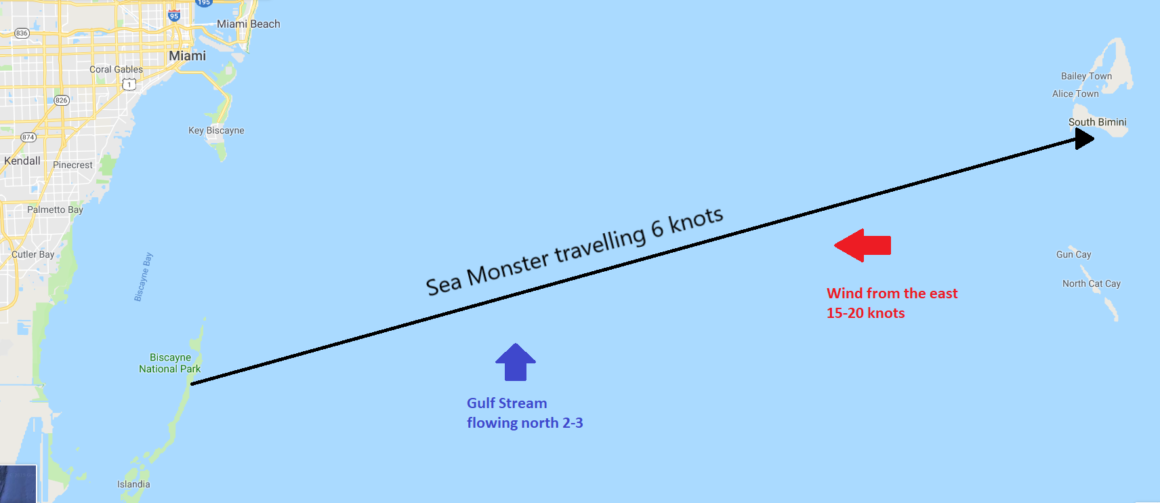
Tangent: The Gulf Stream flows from the south to the north at a speed of around 2-3 knots (that’s fast). If the wind is blowing from the north to the south against the stream, it kicks up big waves. It’s also worth noting that sailboats will often travel at an average speed around 5-7 knots, so having a current push you 2-3 knots in a direction you don’t want to go is difficult enough without large waves.
We had positioned ourselves at the northern edge of the Florida Keys in Key Biscayne area (just north of Key Largo). The idea was to give ourselves a better angle at crossing the stream so that we wouldn’t be pushing just directly east, but could use the fast current to help push us a bit north as well.
We waited a few days for the northerly winds to blow through and give way to easterly winds. Yes, we know these are still not ideal but there were no winds from the west or south in the foreseeable future – so we worked with what we had. We were able to give the seas a day to calm down (a bit) when winds were 20-25 knots out of the east. The next day the winds were 15-20 knots out of the east, which is the window we were waiting for.
Running aground
Did that sub-heading scare you a bit? Not nearly as scared as I was when I ran aground a sand bar at about 7 knots speed. This was also only 2 days after we drug anchor overnight and ended up aground at low tide in the mangroves (story for another time).
We woke up early to get a start on our journey to the Bahamas at about 6:30 am. We pulled up the anchor and began making our way through a small, marked channel (“Angel Creek” – ironic) to exit the Key Biscayne park area and enter the Atlantic. The channel markers were not very reliable and neither was our map showing 6-10 feet of water which was consistently more like 5-6 feet. We draw 4-4.5 feet, so anything less than 6 feet starts to get hairy. We take it very slow and exit what we believe to be the difficult part of the channel. We are still in a channel but it’s wider, appears well marked and the depths are 10-12 feet. Thinking we’re in the clear, we turn up our engines and pick up speed, excited to be Bahama bound.
There was a bang and a jostle as our port keel seemed to run into a brick wall. I slammed the engines into neutral as quick as I could (to protect the props) and we quickly evaluated our situation. Given that we hit something going forward, the first game plan is to simply back out slowly on the exact route. Unfortunately, that doesn’t work this time. Now we notice that we’ve got a pretty good current trying to push us further onto the sand bar. We position our engines to counteract the current as we decide what to do.
We tried lots of combinations of using the engines and rudders to turn ourselves off of the sand bar into deeper water. Our starboard keel was in 10+ feet and both props were free, so it seemed like it should work. It didn’t. We were getting close to trying to “kedge” ourselves off, but before that we tried unloading the dinghy and having Matt drive circles around the boat to create waves. The idea is that a wave could lift the boat just enough to free the keel from the sand momentarily enough to back off the sand. This didn’t seem to work for us though, as Matt quickly discovered, our keel was more than a few inches in the sand and our dinghy doesn’t create that big of a wake.
Tangent: “Kedging” is a method commonly used to try to free the boat when stuck, though more often used for mono-hulls than catamarans. You take an anchor out away from the stuck boat using another boat (e.g. the dinghy) and try to set the anchor by hand (with help of the dinghy motor if possible). You then bring the rode (read rope) that is attached to the anchor and wrap it around a wrench on the boat – most preferably an electric one. You then use the wrench to try to move the boat towards the anchor in an effort to free yourself from whatever you’re stuck on. This along with all other methods of things we tried are when you have a “soft grounding” which typically means stuck in sand or mud and no damage to the hulls. If you have a “hard grounding,” just call for help and pour yourself a drink (or evacuate the boat depending on severity).
After being stuck for about an hour and a half, I was almost ready to admit defeat and call a tow. This would mean we would waste too much time though to be able to cross the stream that day. There were no other days without strong winds from the north for over a week. This would mean we would miss Matt’s family who was supposed to be meeting us in Bimini in just three days. So we kept trying.
Matt used the dinghy oar to shovel/poke away at the sand around the stuck keel. This is an attempt to reduce the “suction effect” around the keel. Think about if you sink your foot into a mud puddle, how difficult it is to pull your foot straight back up – this is the suction effect. We were attempting to alleviate this in order to allow our keel more freedom to move. As our last attempt before kedging, Matt was digging around the keel as I put the wheel/rudders hard to port (so turning left) and the engines in hard reverse – with the port engine more in reverse than starboard (also turning the boat to the left). This seemed somewhat counterintuitive because there was more sandbar to our left – exactly where we didn’t want to go. However, the current was pushing strong at our stern/back, so our thought was why keep fighting it? If we can get our stern to swing out even just a bit, then the current will also push us to turn left which might be enough force to free our keel. At that point, we would be in reverse which should move us back just enough into the deeper water, even if our bow remains over the sand bar it has enough clearance once our keels are free. Thank goodness, this worked like a charm!
The boat was free, I was driving, and it was a bit out of control with all the forces at play. I get it (and myself settled down) and begin to motor slowly towards the end of the channel only a few feet away, telling Matt to just meet me there in the dinghy. Problem – he had tied the dinghy up to the boat while he was working on our suction issue so it wouldn’t float away. So now I have to try to back up with frazzled nerves and a strong current back to the sand bar we were just stuck on. I did it, Matt helped with instructions, and he pulled himself onto the swim platform. We took off, pulling our dinghy back onboard after clearing the channel.
What a morning. I wish I had taken some pictures.
Actually crossing the Gulf Stream
We are free from that dreaded sand bar, there’s no water in our bilges – we relax and make breakfast. It’s 8:30 am now, but based on our GPS, we can still make it to Bimini before dark so we continue on. We’ve got winds out of the east (even slightly south) at 15-20 knots. Given that we’re headed east but a bit north, we decide to put our jib up in order to gain some additional speed. The winds seems to shift as soon as we do that, coming from the exact direction we’re headed. We try to tack once or twice, but quickly decide that we’re racing the clock now and motoring a direct course is the most time efficient.
Our boat, like most others has auto pilot. This is effectively a way to cheat at driving the boat and is simply amazing. You can set it on a specific bearing (0-360 degrees), which I refer to as a specific angle and then it will turn the rudders such to keep you on track – awesome! We use auto pilot a lot and especially on a long, open journey like this. It was amusing to watch though as even our autopilot couldn’t fight the Gulf Stream current. If we wanted to be traveling at a bearing of 80, we’d have to set the autopilot at anywhere from 95-115 throughout the journey to counteract the current.
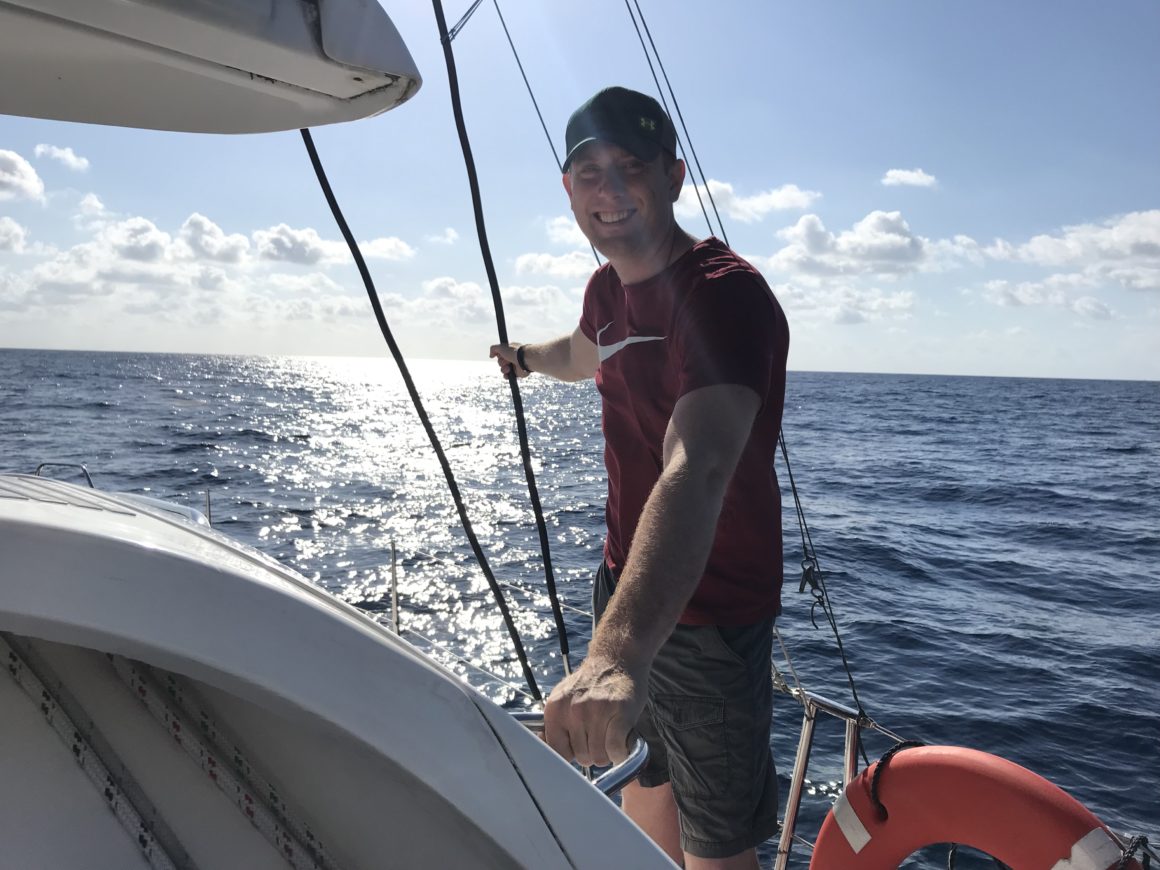
The waves started out a bit larger than the 3-5 foot waves that we saw forecasted. We had waves 5-6 feet most of the time with swells as large as 10 feet at points. I just sat white-knuckled at the helm with Monster and let Matt take care of anything moving around the boat, including bringing us food and water. My sea sickness has largely disappeared, but the second I lost the horizon and stepped inside, I felt like needing a bucket. So I sat mostly content on my bench seat manning the helm and looking over the horizon.
Sadly, we had no dolphin spotting during our crossing, though we did have hundreds of flying fish which was almost as exciting! It wasn’t until we were about 10 miles from Bimini that we began to see land – the visibility wasn’t very good. It was exciting to finally spot it though, and since I saw it first, I got to yell “Land-Ho.”
Anchoring in the Bahamas
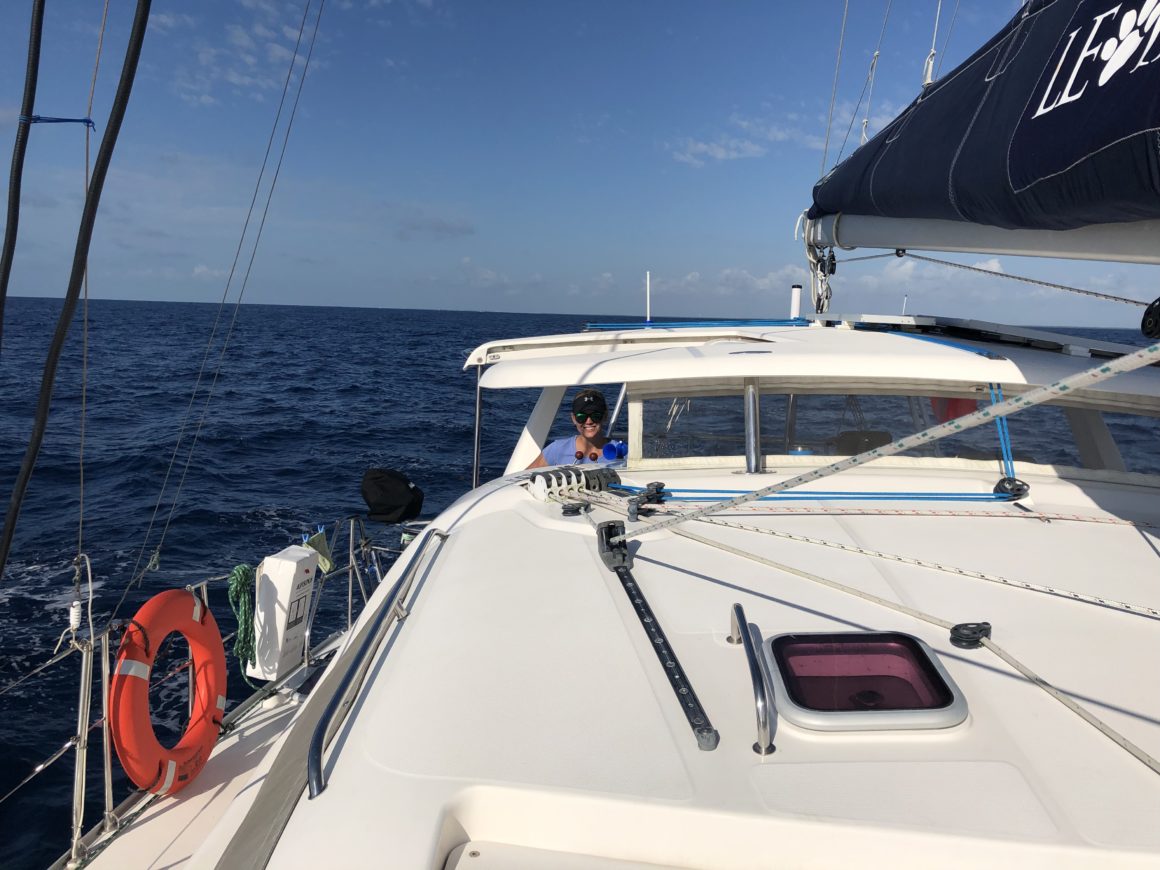
Based on our wind conditions and reviews from our Active Captain app, we chose to anchor for our first night at the southern end of South Bimini. It provided good protection from winds out of the north and pretty good from the east. We arrive to our anchorage a little after 5 pm, which is when customs and immigration close. No worries – we fly the yellow quarantine flag and plan to check in the next morning.
Tangent: When you arrive in another country by sea, you are supposed to fly a yellow quarantine flag to indicate that you have not yet cleared customs and thus are not supposed to be leaving the boat. In the Bahamas, the official rule is that only one person, designated as the captain, is allowed to leave the boat to go to land and check in with customs and immigration. Once they clear, then everyone on the boat that they checked in is allowed to go ashore. Once you have been cleared, it is then customary to fly that country’s flag from the starboard spreader of your sail boat. The home country flag (e.g. US flag) is to be flown as well from sunrise to sunset (ours from the stern of our boat).
We drop our anchor into a turquoise patch of water than appears to be a sandy bottom. It appears to be set, but ever since we ran around one night, I’m terrified of dragging anchor. I decide that with this clear, somewhat warm water it might be time that we start to dive our anchor. This means that one person will dive down and visually inspect how the anchor looks and whether it’s set or not. I previously googled what “well set” anchors look like, so I quickly noticed that we were indeed not set well. I pull up the anchor and try to right it onto the sandy patch again, then Matt slowly backs up the boat to see if we can get the anchor to set. It takes two tries, but we eventually get a strong set that we feel confident about.
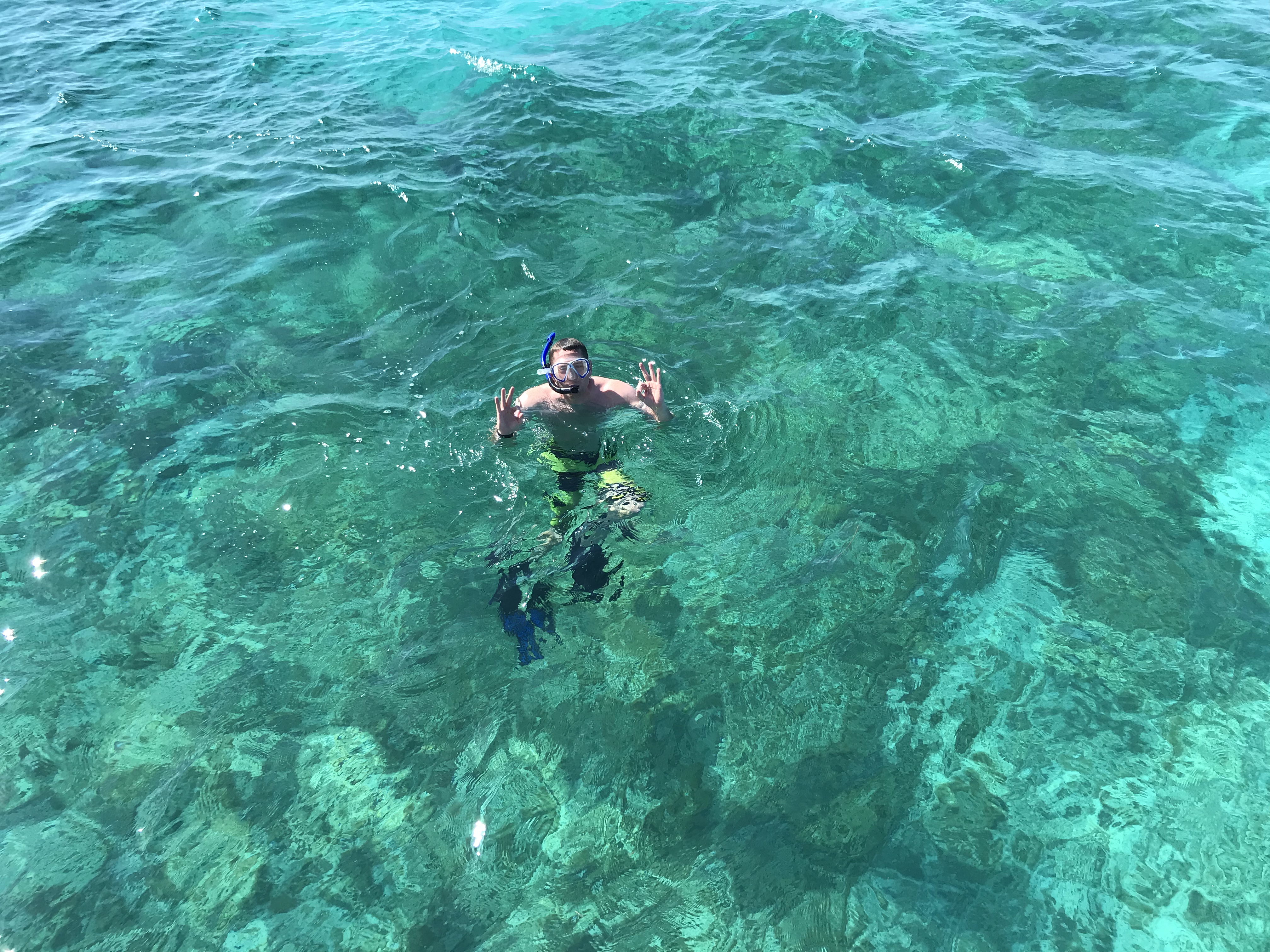
We spend a few minutes snorkeling around the boat – somehow managing to spot a small sting ray, a barracuda, and a few fish in the barren spot we anchored in. This is my first time in the water since we bought the boat – so I’m thrilled to just be in the water, in the BAHAMAS!!
After showering and settling in for the night, we open up a big bay of Lays Ruffles and Dean’s French onion dip to celebrate our success of making it – alive and the boat in one piece.
We’re in the Bahamas. Monster is an international traveler.