
A windlass if a nifty little device that helps you to lower and raise your anchor. In particular, we have an electric windlass which allows us to literally push a button to make the anchor go up or down. This is important because the anchor (and the chain) is extremely heavy. The windlass is one of the most important pieces of equipment on our boat – so of course, it broke.
Leaving Chub Cay (again)
For the second time, we attempt to leave Chub Cay to head over to New Providence Island. For the second time, our boat feels differently. We begin lifting up our anchor (using the windlass) same as always. All goes well until the windlass just decides to stop working with a couple feet of chain left to pull up. I try all the usual “quick” fixes like tightening the power cord connector and a few gentle taps, no luck. We are able to freely move though without the anchor dragging lower than our hull, so we decide to start heading in our direction (we have to move somewhere). Once we get out far enough into the open we put our engines in neutral and head up to the bow to try getting the anchor the rest of the way up. Matt is able to manually pull in the rest of the chain by hand and we get our anchor secure. First problem solved.
Now we head to our giant collection of user manuals to fish out any information we can find about the windlass. We know that there should be some way to manually crank the chain up and down still using the wheel of the windlass. Good news – there is! Feeling a bit more reassured, we continue on our course thinking that we’ll manually drop anchor that night and then do some troubleshooting on the windlass in the following days. As we are still underway, we’re taking turns “practicing” how you would theoretically raise and lower the anchor (referred to as freefall and manual recovery). We quickly realize how appropriate those names are. It seems like the anchor is going to just fall freely (e.g. slam) down to the bottom and then to raise it will be a recovery mission with your arm muscles needing recovery the next day.
We’re only about an hour or so from our anchorage at Chub Cay. At this point, we decide that we should be cautious and just head back. At least we know the anchorage and will have lots of daylight and time to get the anchor set and then begin working on the windlass. If all else fails, there is also the really nice (alas expensive) marina right there that we could go dock at.
Returning to Chub Cay (again)
We motor back to our anchorage – to our spot – and I take over the helm to keep us in one place facing into the wind (proper technique for dropping the anchor). Matt heads up front to manually “freefall” our anchor. Bad news – it doesn’t work. After about 15 minutes and lots of staring from the boat anchored nearby, we switch spots and I give it a go. It definitely does not work. We motor back out to more open seas so we can put the engines in neutral and both look at it together. There’s a metal piece that is very bent and appears to be the culprit as to why we can’t use the windlass manually. Remember that it has this manual option as a safeguard, Plan B in case the electric fails. How the heck do both our Plan A and Plan B fail at the same time? We’re up a creek with no paddle – except this is possibly a worse scenario.

We quickly go online to see if the marina has any availability since it’s really our last option. Luckily they do have a few slips left, so we make a reservation and then get to work putting all our lines and fenders set up. Matt radios them on channel 16 and we wait for directions. Matt radios them again… and again… and a few more times. Come on. At this point I’m about to have an emotional breakdown and just want them to answer the *beep* radio. I try calling this time and they can probably hear in my voice that they should answer, and they do.
Tangent: All boats should be equipped with at least one VHF radio (among other communication devices). This will be the primary means of communicating with other boats and service locations when out on the water. There are several channels or frequencies that can be used – just like the walkie talkies your family used in the 90s to communicate at theme parks. Channel 16 is the international hailing and distress channel. All boats should be monitoring this channel at all times. If there is an emergency (or distress) this is the channel you would call out for help on. It is monitored full time by authorities such as the US coast guard. This channel is also where you can initiate contact with or hail other vessels, marinas, etc. Once you make contact, you would agree to switch to another channel so as to leave 16 free for emergencies or for others to hail from.
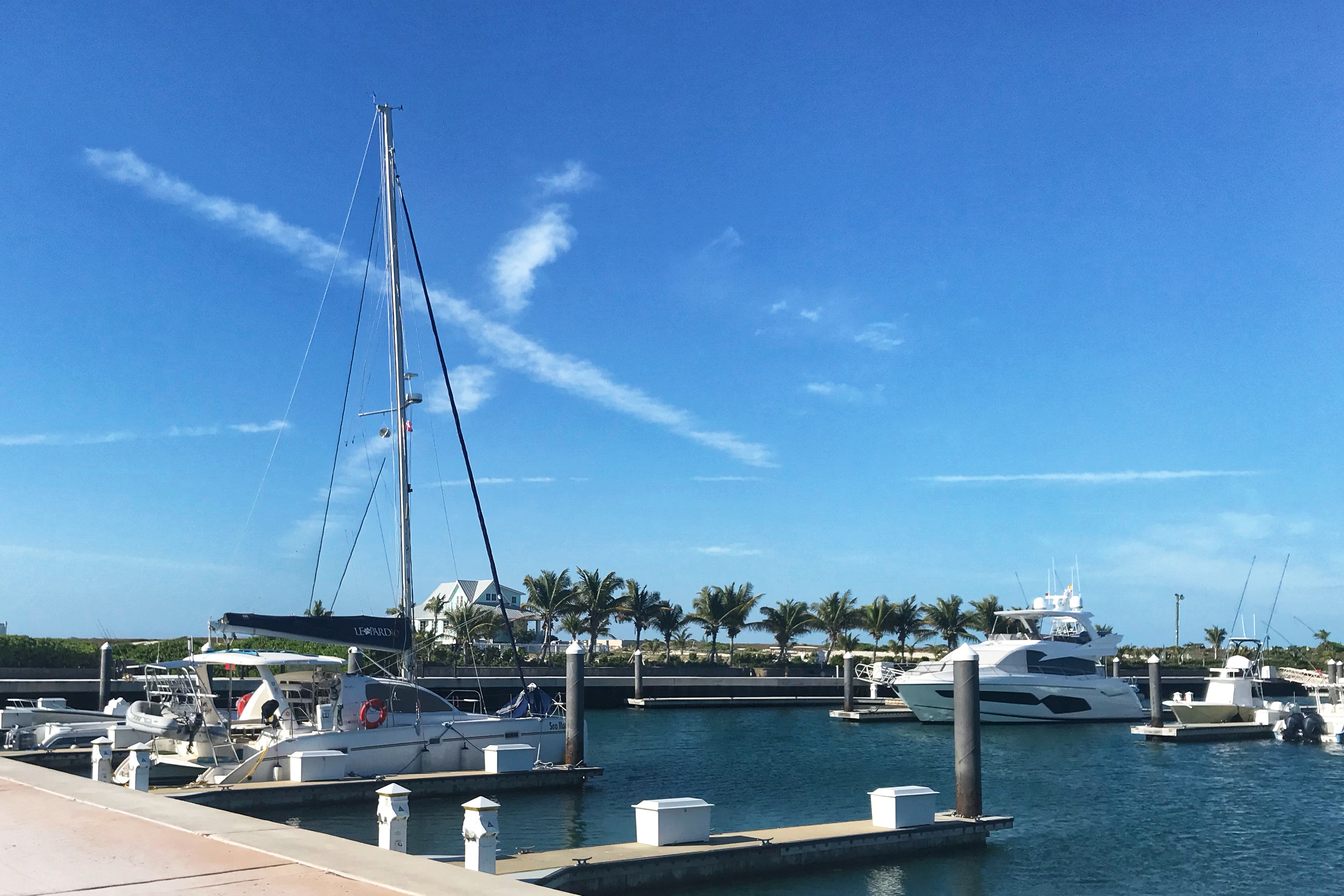
Slowly we maneuver our way into the marina and are assigned a slip number. There’s a gentleman there ready to assist us with tying up our dock lines. This is good – we’ve never tried to completely dock just the two of us. It’s much easier to have someone on the dock that you can throw the first line or two over to. In this case, there’s even more reason we need him there – we have to back into the slip. This is our first time ever backing into a slip. Typically we always do a side-tie, which means we come up to a single long dock with one side of our boat and tie up. The difference between a slip and a side-tie would be similar to parking your car along the curb (with plenty of space) versus backing into a garage.
On his second attempt, Matt gets us into the slip with relatively little headache and no damage! That’s a win.
Working on the windlass
Once we’re safely in the marina, it’s time to put our attention back to our anchor and windlass. Based on our Google research, we believe the most likely culprit of our electrical issue is the solenoids. It sounds like we may just have some corrosion build up (completely normal) that we need to scrub clean so that a strong connection can be made again. As a back-up though we inquire about any mechanics that might be able to come take a look. Shortly thereafter someone comes by our boat and we decide it’s worth hiring him to help us out.
Thank goodness we did. After some investigation, he determined that the issue wasn’t the solenoids but that the windlass simply wasn’t getting enough power. He tested the windlass using an external battery, jumping past the solenoids. (Sorry this isn’t more technical, but I really don’t do well with electrical matters). Basically, that meant that the windlass was fine but that somewhere along the way, the power was getting reduced so much that it couldn’t operate. We have read this being somewhat common that the connection at the operating switch gets lose and just needs to be tightened. That wasn’t the case for us, though, as we had already checked that. The mechanic begins tracing the wire back from the windlass towards the battery and finds the culprit. A spade connector on the positive wire was lose and just needed to be tightened. What a simple fix! One that probably would have taken us forever to figure out on our own though, especially given where it was located (hard to get to of course – it’s a boat).
Our electric windlass is working again – hooray! We have a plan A, but what if that fails – we still don’t have a working plan B. The three of us now focus our attention to the manual function of the windlass. Ultimately, after a lot of tries taking it apart and getting bent pieces back straight (how the heck this metal was ever bent is beyond me), we just settled with ‘good enough.’ If we were to ever need to use it, with a little force, pliers and a hammer – we could make it work. Hopefully we won’t need to.

It’s funny. Before this happened, I was so distraught about the water maker. Now we are just back to where we were two days ago, but actually even a little behind since we’re still in Chub Cay and paying for an expensive marina. We’re so much better off than we were two hours ago, though, that I couldn’t be happier. Who needs a water maker? Or a working freezer? Or working LED lights? Or all the other stuff that’s broken on our boat. We have a working windlass and at this time, that’s all that matters! There’s also a nice sunset over the marina. Ahh, boat life.
Stay tuned to find out if we ever leave Chub Cay or if we’re just going to become permanent residents.

2 comments
We’ve had to deal with a non-functioning windlass as well. Such a pain! When we recently helped our friend bring his boat back from the Bahamas to Florida, I was in awe of how simple anchoring was when you have a windlass that works 🙂
Thanks for emailing and reaching out. I’ve added you to the list of sailing blogs on our site. Looking forward to following along with your adventures.
When we first started out I felt a bit stranded if we struggled to find a marina. By the time the windlass went out, I felt way more stranded not having it (or the manual option) available! Thank you for adding us to your list of other great blogs! I’ll be sure to continue recommending your blog The Cynical Sailor and if we ever grow big enough for our own list of recommended blogs, I will add your blog as well 🙂